Backyard Pests
How to control some of the most common weeds on the Big Island:
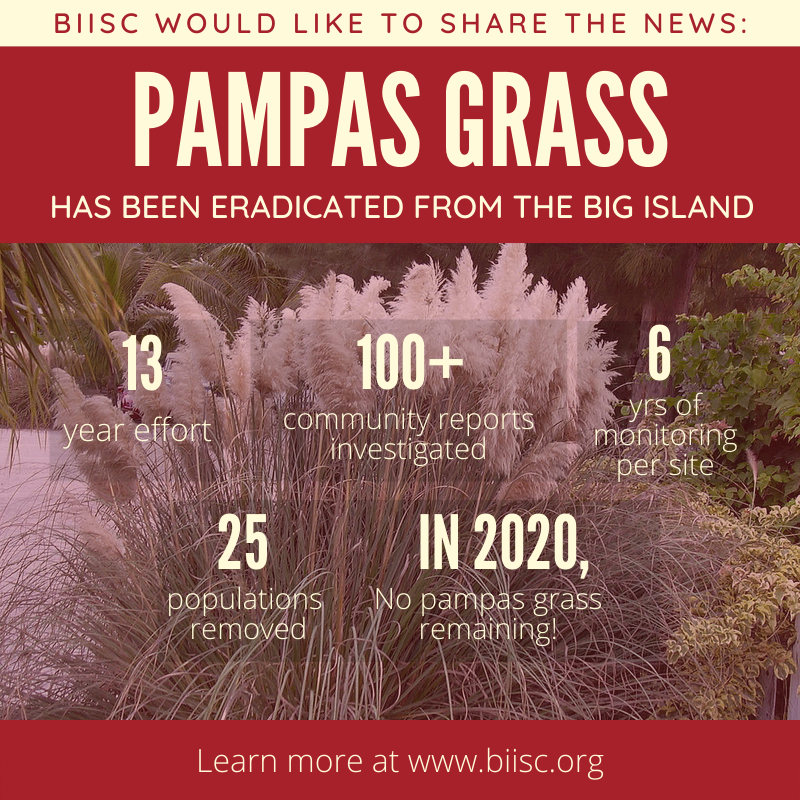
BIISC is happy to share some good news: one of the most notorious invasive grasses in Hawai‛i, pampas grass, has been eradicated from the Big Island! Both species of pampas grass known to occur in Hawaii, Cortaderia jubata and Cortaderia selloana, have been removed, and monitoring continues for any keiki that might appear at the sites of previous known locations.Â
Both species of pampas are on the state’s Noxious Weeds list. The South American plant was shipped around the world in the late 1800s, popular for the showy plumes used in fashion and decor. It grows in large clumps, with feathery white or lavender plumes growing up to 10 feet tall. As people planted it across the Pacific, it slowly began jumping from planting sites and spreading out into natural areas, disrupting native ecosystems in places like New Zealand, California, and here in Hawaii. It is now widespread on Maui, and because it is adapted to fire in its native range poses a significant threat as a fuel for wildfires.
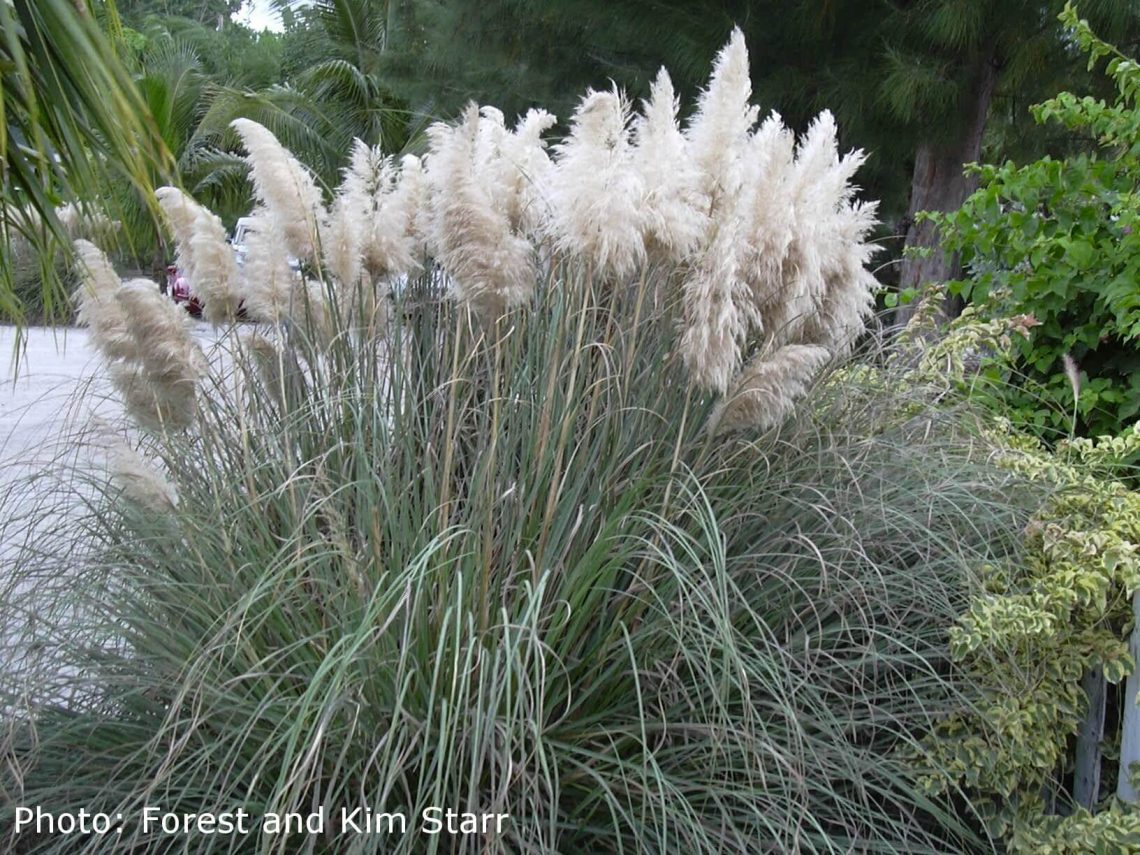
Pampas grass is a noxious weed.
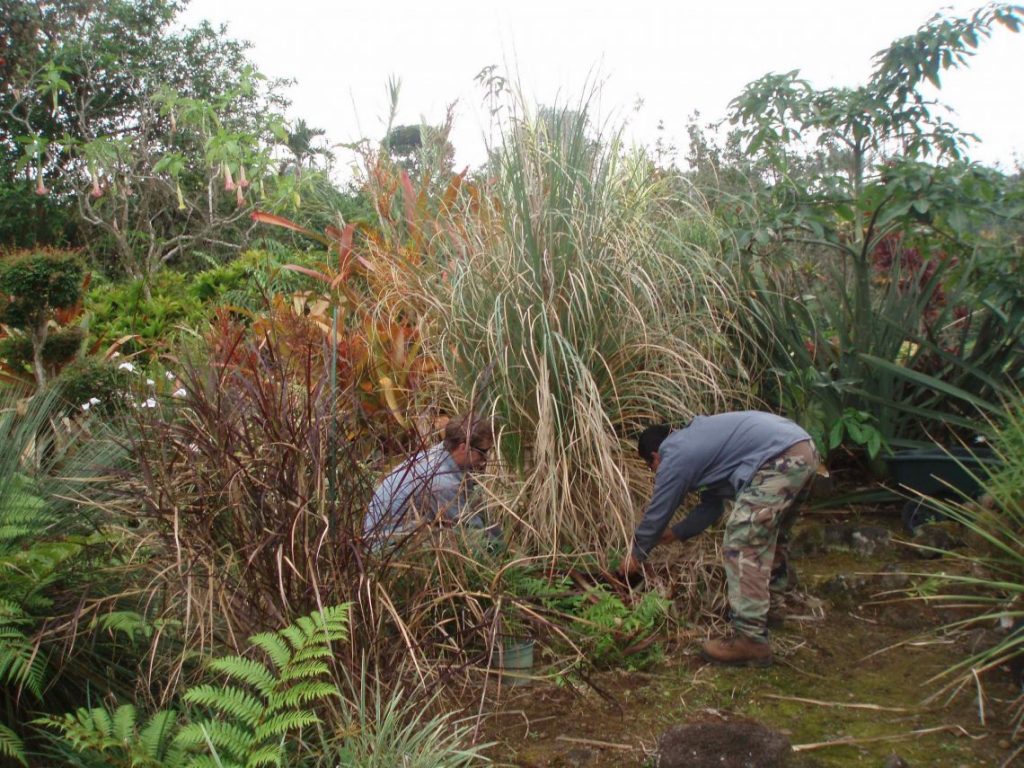
BIISC staff controlling pampas grass.
When the Hawai‛i Island eradication effort began in 2007, the plant was mapped in over two dozen locations including several places in Volcano and on the West side of the island. Although most of the adult plants were removed early in the eradication timeline, Joel Brunger, our field operations supervisor, points out the challenges of surveying for other pampas grass clumps near an adult plant: each grass clump is capable of producing thousands of lightweight seeds which are carried by the wind as far as 20 miles from the parent plant!
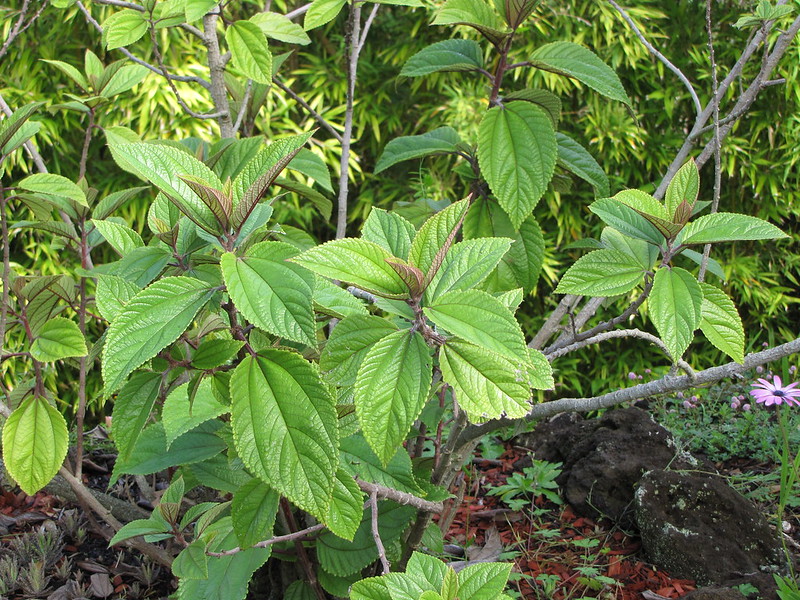
BIISC relied heavily on reports from the public about potential pampas sightings, carefully tracking down and identifying each plant to locate any previously undiscovered populations. Removal of the plants by BIISC crews took time, as permission from property owners was required for most of the sites. Locating and contacting property owners can pose a significant challenge for our control efforts, but overall most people were cooperative and eager to support the removal of an invasive plant from their property. The Hawaii Department of Agriculture assisted with securing access for removal of the noxious weed where permission was difficult to obtain. Finally, in 2019, the last known population of pampas was removed, and native māmaki was planted in its stead. BIISC botanists continue to monitor the area to catch any keiki plants that may spring up.
Despite the razor-sharp leaves and potential for fueling wildfires, pampas grass is still sold throughout the world in the horticultural trade and used for landscaping. During the course of the eradication effort, BIISC developed the Plant Pono program, a nursery endorsement and education effort aimed at stopping the sale of invasive plants in Hawaii. Pono-endorsed nurseries voluntarily pledge to sell only non-invasive “pono†plants. There have been no sales of pampas grass in Hawaii for the last several years, although seeds purchased online continue to be a risk for introductions of invasive plants.
If you spot an online seller promoting pampas grass and allowing shipment to Hawaii, pass the info along to us! Often, just informing a well-meaning grower outside of our state about the potential risks is enough for them to stop any shipment of the plant to the islands.
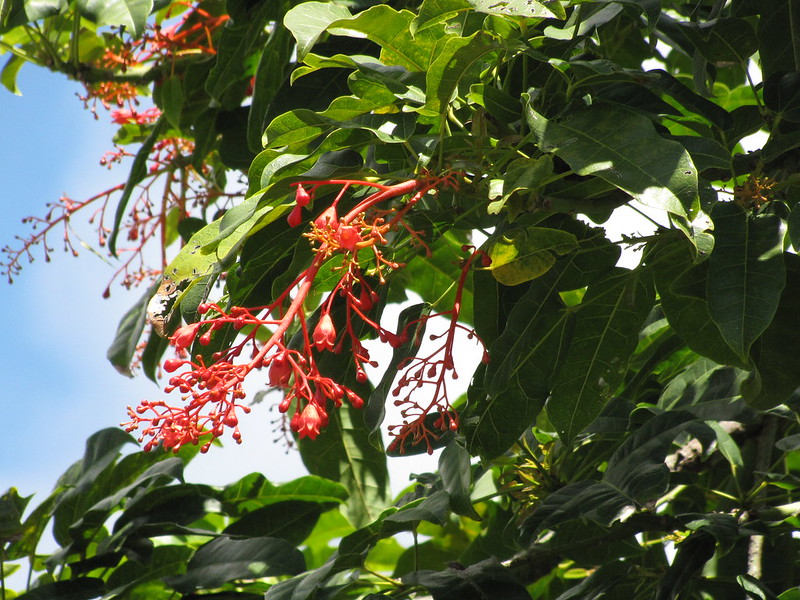
BIISC takes the lead on early detection and rapid response to new invasive plant species, which means our teams search for new species of plants on the island and target them for eradication when necessary and possible. Efforts to control many of our most notorious widespread invaders like miconia, albizia, or strawberry guava came too late, well past the time when it was economically possible to remove those species from the island. There is only a short window of time when an invasive species can feasibly be eradicated. Once that window has closed, control strategies switch to other efforts, like containment, or at the furthest point, exclusion only from high-value areas.
Currently, BIISC is targeting several invasive plant species assessed to be within the “window of eradication.” These species are not yet widespread, and BIISC crews are working to remove them now so that they will not become the albizia or miconia of the future. Visit our target species page to become familiar with our target species, and be sure to report any new or strange plants you encounter!
Philadelphia, PA. I began my career in the financial industry, but always had an interest in the environment and natural resources. After working for a sea turtle conservation program in Greece, I wanted to pursue a career in conservation. I moved to Hawai’i and worked in non-profit, and eventually earned my degree in biology from UH-Hilo. As a student, I developed a love for the forests of the Big Island and a passion for protecting and caring for the unique natural landscapes here. After assisting on several ecological research projects with the Forest Service, I moved into education, teaching science full-time at Big Island public and charter schools while earning my master’s degree. I still am very committed to the young people of our island and getting students out of the classroom and into the forest.

Hendersonville, North Carolina. Growing up in the southern Appalachians gave me a love of the outdoors and showed me how invasive species can affect native landscapes. I am grateful to be able to combine my background in wildlife biology and GIS to help BIISC understand the trends and patterns in invasive species spread, to better target control efforts, and stay aware of emerging issues.

Makati City, Philippines. I used to live in California before relocating to Hilo. I previously worked in research administration at the University of California. I moved to Hilo because of the warm climate, beaches, rainbows, and lush tropical setting. Natural resources are irreplaceable, and conservation is the only way to prevent exploitation, destruction, or neglect of our environment for us and for future generations to enjoy this wondrous place. I acknowledge all the efforts of the BIISC staff in restoring the land, and as the fiscal and program associate, I will play an active role in dutifully administering resources to support the program.

Honolulu, Hawai‛i. Born in Honolulu and raised in Eastern Canada on Lake Ontario, I graduated from a college in Quebec with a degree in Natural Sciences: Applied Ecology. I have worked in the field of conservation biology on the Big Island for over 20 years with agencies such as the United States Geological Survey-Biological Resource Division (USGS-BRD) in Hawai‛i Volcanoes National Park, Operation Miconia, DLNR – Natural Area Reserve Systems (NARS) working with our most invasive species and our most endangered. It is my belief that collectively we can make a difference when it comes to the environmental challenges faced by our native ecosystems here in Hawai‛i and throughout our amazing planet’s diverse ecosystems.

Idaho. Raised in the forests of the Northwest, I grew up with an appreciation for the environment and biodiversity found in the world around us. Today, many of those forests are forever changed due to an invasive beetle killing entire stands of pine trees, and devastating wildfires fueled from the remaining dead timber. The threat of new invaders taking hold and destroying native forests and habitats is neverending. Working with BIISC in conservation allows me to lend a hand in the larger effort to keep invasive species from becoming established on Hawai‛i Island, and combat those that have already reached these shores.

Victor, NY. I had a strong desire to work in the natural environment from an early age. My passion began when my father and I planted hundreds of trees in our backyard for an Earth Day celebration. Watching the seedlings grow into a forest was satisfying. I understood then that a career in conservation would keep me happy. At BIISC, I work with the horticulture industry halting the sales of invasive plants. Managing the content for plantpono.org is another way I help prevent invasive species’ cultivation. Prevention is best!

Hilo, Hawai‛i. My first experience in conservation was during the summer of my junior year in high school. Going through KUPU’s Youth Conservation Corps really piqued my interest in this field. From there, I went on to pursue a degree in tropical horticulture from UHH. The biggest influence that directed my career path was working as a volunteer for Dr. Hara, the entomologist at CTAHR that specialized in pest treatments for tropical flowers and foliage. I went on to be a student help and then a temporary hire after I got my degree. While working at CTAHR, I was able to help different nurseries around the island with their pest problems ranging from ants, slugs, beetles, and even coqui frogs. Now at BIISC, I can take what I learned and use it to help the community rid itself of the little fire ants and other invasive insects.

Panaʻewa, Hawai‛i. My journey with BIISC started shortly after graduating with my bachelor’s degree from UH-Hilo. I worked as a PIPES and then Kupu intern on the outreach team and helped launch our little fire ant community support program back in 2016. I quickly realized how meaningful these kinds of programs are and knew that I wanted to pursue a career in outreach and environmental education. I have since obtained my MS in Tropical Conservation Biology and Environmental Science from UH-Hilo and strive to combine my passion for graphic design, photography, and storytelling to serve my community.

Fairhope, AL. Born and raised on the Gulf Coast, I grew up with a strong connection to the environment. After working at a summer camp on Mobile Bay, I knew I wanted to work in human dimensions of natural resource conservation. I graduated from Auburn University with a B.S. in Natural Resource Management with a focus in Nature-Based Recreation and Ecotourism. After I completed my degree, I worked on a community-based ecotourism project for the Mali Tribe in Fiji through Bridge the Gap: Vorovoro Island. This experience led me to pursue my M.S. in Tropical Conservation Biology and Environmental Science at UH-Hilo, where I returned to Fiji for my master’s project. I started working for BIISC’s outreach and education team as a student assistant during my master’s. This was a great way for me to learn about and be immersed in community-based conservation efforts on the Big Island throughout my education.

Hilo, Hawai‛i. I was raised in Hilo and brought out to field sites at a young age. My involvement in Hawaiian conservation took off with working in the HYCC (with Jade!) and various KUPU internships with the Forest Service and UH while at Hilo High and on through my time at Dartmouth College, where I got a B.A. majoring in ecological biology. I have worked in tropical ecology from Costa Rica to New Zealand, but love that fieldwork in Hawai‛i has neither venomous vipers nor ferocious possums. Preserving Hawai‛i is important to me because I have had the opportunity to visit so many of its pristine natural areas that are now threatened, and have seen the changes in the landscape by both invasive species and by reforestation efforts. Traveling the world has reinforced for me just how unique and special Hawai‛i’s ecosystems are.

Wainaku, Hawaiʻi. I was born in Waimea and raised in Wainaku, Hilo Palikū. I’m an Environmental Studies undergrad student at UH Hilo. My formal experience in conservation began with PIPES internships. At Miloliʻi I worked with Conservation International identifying coral profiles and doing outreach with Miloliʻi ʻohana. My second internship was with Nāpuʻu Conservation Project at Nāpuʻupūʻalukinikini where I supported their field crew with maintaining firebreaks and outplanting native dryland species. I’ve done a 6 month stint in Papahānaumokuākea Marine National Monument on Hōlanikū with Kure Atoll Conservancy focusing on habitat restoration for Hawaiian seabirds. Being an ʻōlapa has pushed me to engage with my natural environment from a young age, and to interact with these spaces in a cultural context with intent, purpose, and reverence. Being grounded in practices of aloha ʻāina and hoʻomana drives me in my career as a conservationist, as it is a vessel for me to take care of and protect that which has fed me my whole life.

Kailua, Oʻahu. From the snow-capped puʻu of Maunakea to the still waters of Kawainui Marsh, I’ve had the privilege of working across dynamic Hawaiian landscapes alongside passionate stewards. My interest in invasive species management has only grown through my ecological education both at UH Hilo (BS) and Mānoa (MS). I continued broadening my knowledge regionally through my work with the Pacific Islands Climate Adaptation Science Center and bio-culturally through my experiences with Hālau ʻŌhiʻa. Today, I live in Waiākea Uka and my daily conservation inspirations are the native plants that continue to grow, the native birds that still soar, the native insects that still appear to the keen eye, and the people who continue to aloha our special places.

Hartford, Wisconsin. Raised in Hakalau. I graduated with my Tropical Ecosystem & Agroforestry Management (Team) AS degree in 2019. I always loved immersing myself in outdoor activities. It is a special gift to work in Hawaii’s native forests. The brisk breeze running through the air, and the abundance of life surrounding trickling streams creates a peace of serenity. I can not imagine a day where our forest disappears. I am always interested in learning new ways to help protect the forest and reciprocate my knowledge to help others.

Austin, Texas. I was born and raised in Austin, Texas, and after spending three years living and working on Oʻahu, I relocated to Volcano, Hawaiʻi, in 2025. I graduated from Texas State University in San Marcos, TX, earning a Bachelor of Science in Wildlife Biology. Since then, I’ve continued to build my professional experience through fieldwork, research programs, and conservation-focused roles across different ecosystems, including Hawaiʻi, Costa Rica, and Colorado. During my time on Oʻahu, I served as the Watershed Support Technician Leader with the Wai’anae Mountains Watershed Partnership. I volunteered at the Bishop Museum on Oʻahu, assisting with vertebrate specimen preparation for research and education. I was accepted into the OTS LSAMP REU and Post-Baccalaureate Programs in Costa Rica, where I conducted tropical field research which deepened my understanding of global conservation challenges. Before moving to Hawaiʻi, I worked with the Southwest Conservation Corps in Colorado, focusing on fire mitigation and chainsaw operations in remote mountainous environments. I’m inspired by Hawaiʻi’s incredible ecosystems and the need to protect its native species. Working in conservation and invasive species management gives me the chance to make a real, hands-on impact in restoring ecosystems and maintaining healthy, thriving environments for Hawai’i. I’m motivated to use my field experience to help care for the land and preserve Hawaiʻi’s natural and cultural heritage for future generations.

Hilo, Hawaiʻi. I was born and raised in Hilo on Hawaiʻi island and currently reside in the ʻahupuaʻa of Waiākea, where I have lived for 24 years. I graduated with my Associate’s in Science under the Tropical Ecosystem and Agroforestry Management program at Hawaii Community College. During my time at HCC, I was an intern at a native plant nursery where I would assist in nursery maintenance, propagating & transplanting native plants, as well as out-planting. I have previously worked as a Field technician and supervisor at Forest Solutions Inc. for 5 years, which I started as an intern back in 2020, and eventually became a permanent hire. I work in Hawaiʻi conservation as a kanaka māoli, serving as a responsible steward of ʻāina by protecting these precious ecosystems for future generations to experience and develop relationships with. I strongly believe that indigenous knowledge should be at the forefront of all conservation in Hawaiʻi while also adopting methods from Western science to further prove indigenous concepts of land management. I am inspired by the valuable ʻike kupuna embedded within our natural environment, and with this knowledge, a closer relationship with ʻāina and culture is made possible. I continue to be inspired by the many kanaka who dedicate their time to aloha ʻāina, as well as perpetuating a goal of indigenous excellence.

Denver, Colorado. I graduated from the University of Hawai’i at Hilo with a degree in Astrophysics and a specialization in Biology. While I was in school, I interned at NASA, which ultimately helped me realize that astronomy wasn’t the path I wanted to pursue. Since moving to Hawai’i a few years ago, I’ve developed a deep appreciation for the islands’ native plants and animals and seeing the passion my friends in conservation have for their work inspired me to join the field as well. Working with BIISC gives me the opportunity to serve my community by helping to protect our niu, and other prized endemic and canoe plants, from the Coconut Rhinoceros Beetle.

Hilo, Hawaiʻi. Growing up in Hilo, I am forever grateful to have parents that always took the time to teach me about the natural environment around me: from invasive and native plants around us to the fish we would catch on weekends. I pursued my Bachelors of Science in Plant and Environmental Protection Science, then later my Master of Science in Plant Pathology, both from the UH Manoa. I’ve had the opportunity to work with conservation organizations such as the Keauhou Bird Conservation Center and the Hawaii Snail Extinction Prevention Program. With these experiences I was able to meet so many passionate people and have further shaped understanding how interconnected Hawaiʻi’s conservation challenges.

Papakōlea, Oʻahu. Originally from Oʻahu but grew up in Hilo, I am a recent graduate of Hilo High School and a member of BIISC’s Plant Crew through the Kupu ʻĀina Corps program. I’m gaining hands-on experience working in the field with both native and invasive plant species and look forward to building knowledge that I can share with my kaiāulu. I’m excited to develop skills in invasive plant management and learn more about protecting Hawai’i’s ecosystems through this experience.

Waiākea, Hilo. Born and raised in Hilo and now living in North Kona, ʻāina has always piqued my interest. My journey in conservation began shortly after receiving my B.A. in Sociology with a minor in Political Science by participating in the PIPES internship program. I was able to work with the Sierra Club of Hawaiʻi to merge my passions of legality and kaiāulu in Hawaiʻi. Through this program, I became aware of the systemic issues facing ʻāina in Hawaiʻi and wanted to use what I had learned to aid conservation efforts in my home. I am currently working with BIISC as an intern through the Kupu ʻĀina Corps program on the outreach and education team. I look forward to educating and advocating for the human and non-human kaiāulu in Hawaiʻi through practicing aloha ʻāina.
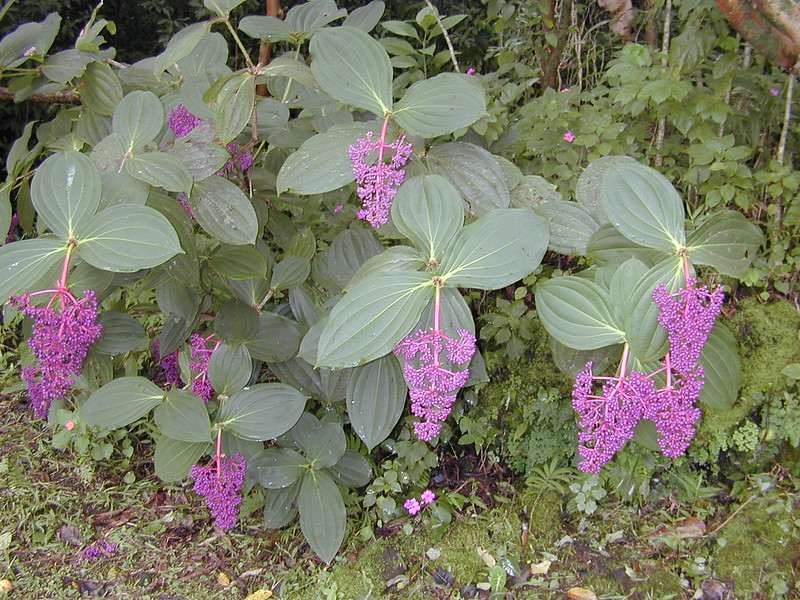
DO NOT PLANT: Any high-risk members of this genus
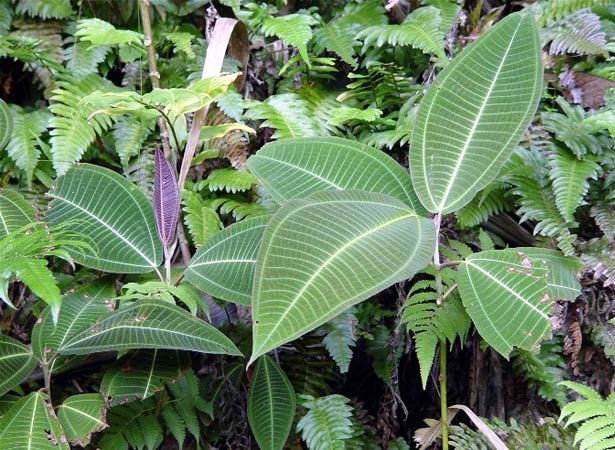
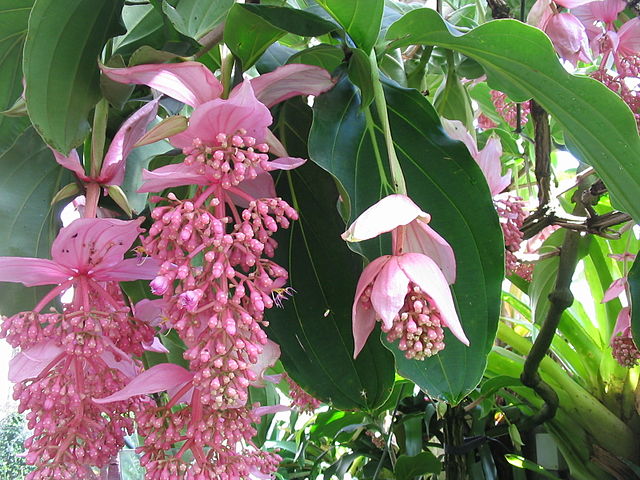
Many plants in the Medinilla genus and Melastomataceae family are weedy and extremely invasive in Hawai’i. The seeds are dispersed by birds, water & and unintentionally as a result of human activity (i.e. muddy boots). Worse yet, humans are a major disperser of this family. Seeds, propagules, and clippings are shared and sold due to their beautiful flowers and attractive foliage. They often produce more than 1,000 seeds per square meter per year, and they can persist in the seed bank for more than a year. Furthermore, they thrive in a wide range of elevations demonstrating their environmental versatility. This family is disturbance-adapted and can effectively colonize a disturbed area. Destructive to native habitats, these plants are very aggressive and shade out, crowd out, and smother surrounding vegetation, forming dense stands. These plants are horrible pests and very hard to control.


Photos: Alberto Salguero, BIISC
Photos: Forest & Kim Starr