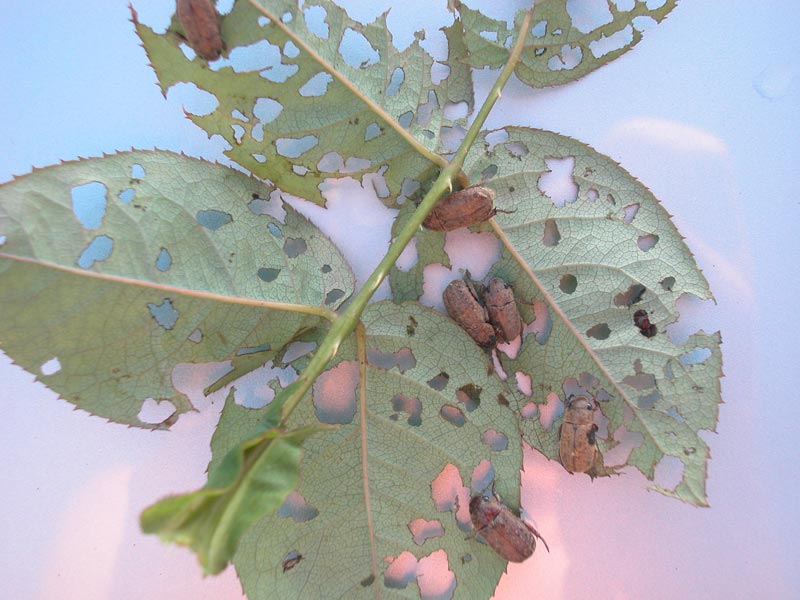
Chinese Rose Beetle
Photo by Arnold Hara
This pest is widespread
You may not notice these annoying beetles but you probably see all the damage they cause. They feed on the leaves of plants leaving them covered in holes or even eating the entire thing except for a few veins. Leaves often look ‘lace-like’ with lots of little holes.
The Chinese rose beetle is a common pest in gardens with a huge appetite. It has a large host range of over 500 plants, both ornamental and edible. Native to Japan and Taiwan, the Chinese rose beetle has spread throughout South Asia and the Pacific. It is now well established in Hawaii.
These beetles are nocturnal and like to feed at dusk for a couple of hours. When they are done feeding they may spend the rest of the night hiding. During the day they hide under leaves, in leaf litter, or even buried in the top layer of soil.
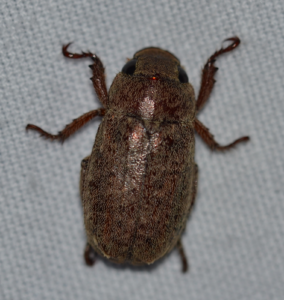
Chinese rose beetle is in the family Scarabaeidae, the scarab beetles. There are more than 250,000 scarab beetles around the world. Hawaii does not have any native scarab beeltes, but there are many that are established here.
Detected in Oahu during 1891, later established on all main islands by 1898.
Only two years after its 1891 sighting on Oahu, it was recognized as a “serious pest” locally, before becoming common on all main islands and one of the worst plant pests by 1917. It is thought to have arrived as larvae within soil brought in from China, Taiwan, Java, and Timor.
Adults travel by flying. However, they are attracted to ethylene gas, which plants release from damaged leaves. Strong wind not only helps beetles travel far distances, but storms that cause plant damage are likely to produce suitable feeding and breeding spots. It lives in agricultural land, native non-native forests, residential areas, and even coastal areas.
Life Cycle
Chinese rose beetle has a moderately-long lifespan, as it lives for 14 to 17 weeks. However, it may complete its lifespan as quickly as 6 or 7 weeks in conditions that are very favorable. After the egg is laid in the top layer of soil, a grub hatches in 12-16 days. From there, it lives for 21-28 days before pupating and remaining a pupa for 11-17 days. After emerging as an adult beetle, it lives for about 56 days. It is unknown how many generations that A. sinicus has per year, but each clutch has about 50 eggs.
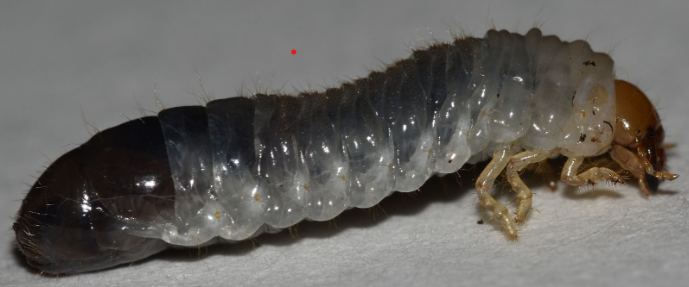
Ph
Description:
- About 1/2 inch long
- Oval shaped
- Reddish brown, and covered in tiny whiteish hairs
- Larvae are fat, pale, with a brownish head
- Similar looking to Coconut Rhinoceros beetle, but Chinese rose beetle crawls rightside up
Impacts:
- Feeds on leaves of numerous plants
- Excessive feeding can reduce plant yields and eventual death if damage is extensive
Getting Rid of Chinese Rose Beetle
As annoying as these beetles can be; controlling them can be rather simple. You have a few options.
Lighting
To protect certain plants from beetle damage you can set up a bright light to shine on them for a couple hours after the sun goes down. While the beetles are partially attracted to light they are also deterred by very bight lights. Since they mainly feed around dusk the light only needs to stay on for a few hours, not all night.
Light Traps
There are multiple ways to make a light trap. The main idea is to use a dimmer light suspended over soapy water. The light attracts the beetles and they fall into the water, the soap breaks the surface tension causing them to drown rather than float. You can create standing traps or just position a bucket/container beneath an outdoor light.
Hand Capture
This is probably the easiest method of control. Go out at dusk or just after it gets dark with a container of soapy water and pick the beetles off your plants. They don’t scatter very quickly and are easily knocked into the water.
Physical Barrier
Applying shade cloth around small plants, young trees, or plants that have been recently transplanted. Transplanting can cause some stress which can attract beetles.
These methods may not work to reduce populations 100% but it will greatly reduce the amount of Chinese rose beetle in your garden and reduce the amount of feeding damage on your plants.