What started as a discarded botanical specimen, has now become one of Hawaiʻi’s most invasive horticultural plants. Miconia, scientifically known as Miconia calvescens, was imported to Hawaiʻi Island in the late 1950s/ early 1960s as a botanical specimen. Legend has it that the first Miconia plants died, and the pot was left under a dark greenhouse bench. Moments later, new plants were found in the pot and the plants were quickly shared among plant enthusiasts on the East side of Hawaiʻi Island. Just 20 years later in the 1980s an expanding population around Onomea was observed and unfortunately, removal efforts were not sufficient for eradication. Fast forward another 20 years, and by the early 2000s it was obvious that Miconia would be impossible to eradicate on Hawaii Island.
What makes Miconia so invasive?
Miconia is known to form thick stands that shade out native plants and completely take over wet forests in Hawaiʻi. Its massive leaves form a dense canopy, blocking sunlight and suppressing native groundcover vegetation. Their shallow root systems promote erosion leading to a decline in the quality of surface water, ultimately increasing sediment in shore runoff. This disruption reduces groundwater recharge, increases runoff, and threatens the delicate balance of the watershed.
Miconia reaches reproductive maturity in as little as 4 years, producing fruit 2-3 times per year—each event yielding an astonishing 3 million seeds, or up to 9 million annually. Compounding the problem, Miconia seeds can remain viable in the soil for more than two decades, making landscape eradication impossible. Without consistent control efforts, this invader continues to reshape our ecosystems, outcompeting native species and altering landscapes at an alarming rate. With the proper tools, homeowners can control this pest on their property.
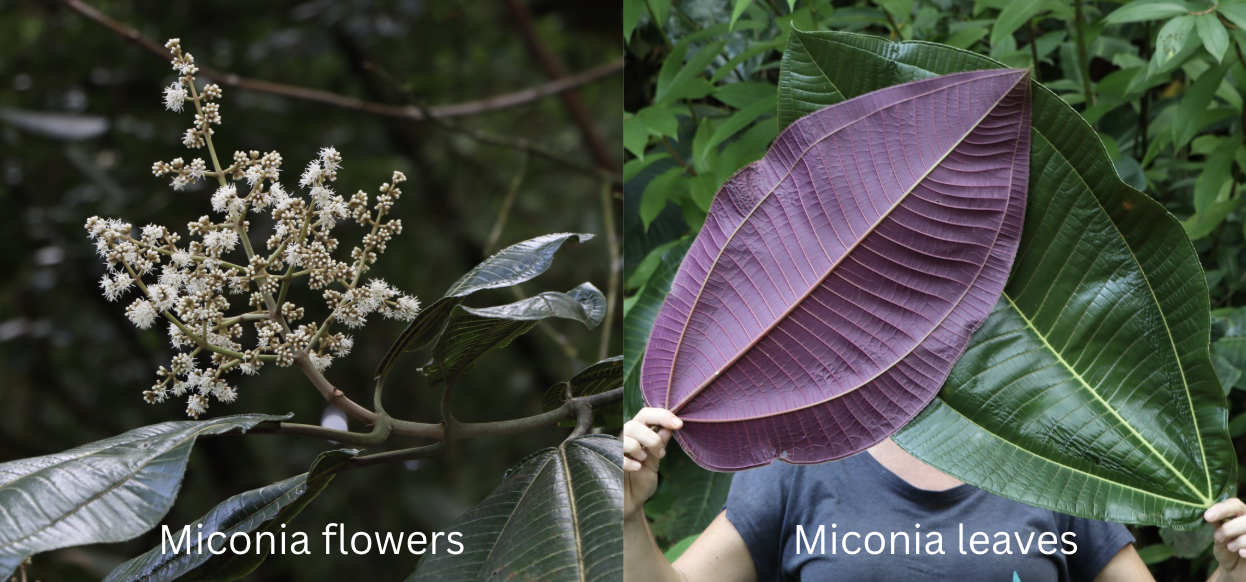
Controlling Miconia
Physical control:
- Pull small saplings out by hand. If uprooted completely, the success of control is 100%.
- Cut mature trees and repeat as needed. Monitor every 6 months because multiple stems will regrow from the stump.
Chemical control:
When using herbicide, always follow product labels and Personal Protective Equipment requirements. Both of the herbicide applications below are targeted and precise with extremely low risk to neighboring plants.
Thinline Basal Bark Treatment:
- For trees with LESS THAN 6-inch diameter (about two hands in a circle), use an oil-based undiluted triclopyr product with at least 50% active ingredient, such as Alligare Triclopyr 4.
- Drip the herbicide in a continuous line around the miconia trunk. Wet the entire circumference of the stem, but not so that it drips. No bark needs to be removed, but you should wipe away any moss or soil that is present.
Cut Stump Treatment:
- For trees with MORE THAN 6-inch diameter, cut down miconia leaving only a 1 to 2-inch stump. Apply an oil-based triclopyr product with at least 50% active ingredient, such as Alligare Triclopyr 4.
- Mix according to the label at 20%-30% dilution and immediately spray or paint onto the top of the stump once cut. The most critical area to cover is just inside the bark.

Disposal of Miconia green waste
- If no fruit or seed is present, vegetation can be hung to dry completely. Miconia will regrow if roots touch the ground.
- For small amounts of fertile vegetation, place in a thick black garbage bag. Leave in the sun to solarize for a minimum of 15 days and heat above 130°F daily.
- For large amounts of fertile vegetation, make a ‘tarp burrito.’ Spread out a tarp or heavy plastic sheet, pile it in the miconia, and wrap it up completely. Leave in the sun until all leaves are dead and the stems can snap.
Miconia is a noxious weed, do not throw it in Hawaiʻi County Green Waste. If the vegetation cannot be disposed of onsite, put it in the landfill.